Germany’s transition to electric mobility continues to accelerate, driven by policy support and growing consumer confidence. Battery electric vehicles (BEV) accounted for 13.5 % of all new registrations in 2024, while 191,905 plug-in hybrids represented a 9.2 % year-on-year increase and a 6.8 % market share [1]. The trend strengthened further in 2025: in April alone, 45,535 new BEVs were registered, a 53.5 % rise compared with April 2024, bringing the market share to 18.8 %. Plug-in hybrids also grew by 60.7 % to 24,317 units, reaching a 10 % share of total passenger car registrations. Together, electrified vehicles made up nearly one-third of all new cars, confirming that demand for zero-emission mobility remains strong even after the phase-out of purchase incentives [2].
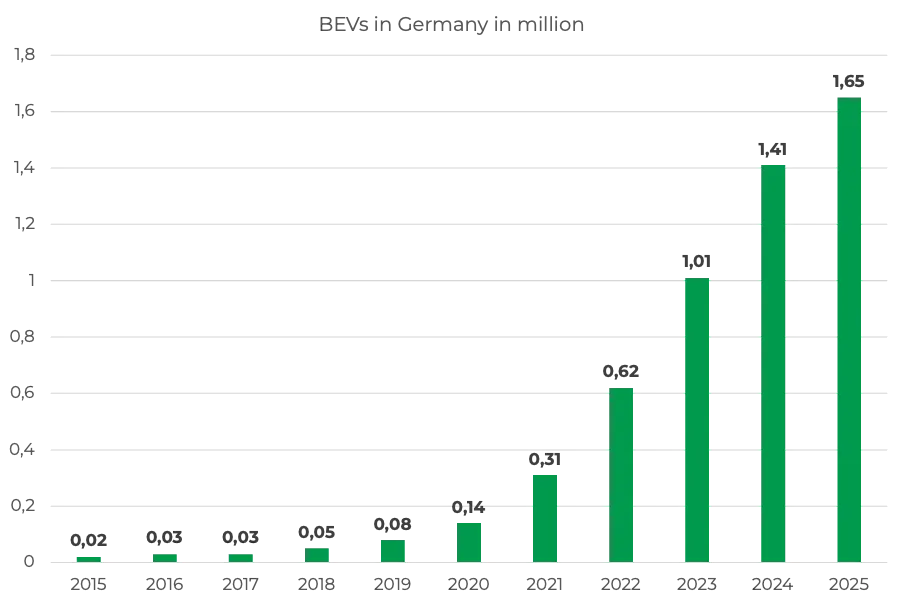
Figure A: Battery Electric Vehicles (BEVs) in Germany – based on [3]
This rapid expansion reflects the accelerating pace of electrification, yet it also highlights the widening gap between vehicle adoption and the availability of public charging infrastructure. As of October 1, 2025, Germany recorded a total of 179,938 publicly accessible charging points nationwide, representing an increase of 15.6 % compared with the previous year. The combined installed capacity reached 7.33 GW, reflecting the continued expansion of the country’s charging infrastructure [4]. Among these installations, 135,691 are standard AC chargers and 44,247 are DC fast chargers, corresponding to a ratio of about 3:1. In other words, around three quarters of all charging infrastructure in Germany operates at standard power levels, showing that accessibility and network coverage remain the primary focus rather than fast charging [3].
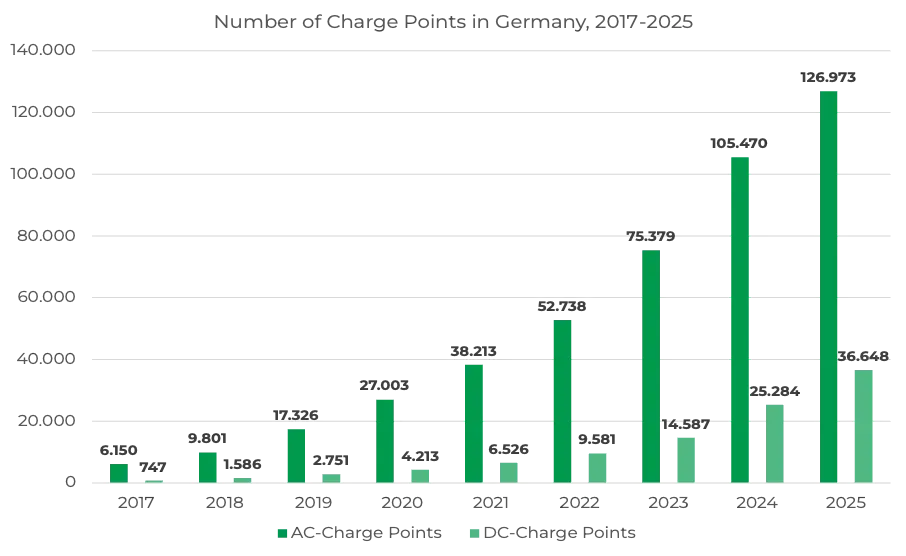
Figure B: Number of Chargepoints in Germany – based on [5]
The distribution of these chargers, however, remains highly uneven across the country. Most charging infrastructure is concentrated in urban and metropolitan regions, while large rural districts continue to fall behind. Data from the National Centre for Charging Infrastructure (Nationale Leitstelle Ladeinfrastruktur) indicate that over 70% of all charging points are located in or near major cities, whereas almost half of all municipalities do not yet have a single public charging point. In rural areas such as Brandenburg, Mecklenburg-Vorpommern, and Lower Saxony, the average charger density is below 5 units per 100 sq km, compared with more than 40 per 100 sq km in metropolitan regions [3]. This imbalance reveals one of the central structural challenges of Germany’s energy and mobility transition. While charging networks in cities continue to expand rapidly, rural regions still face limited grid capacity, high installation costs, and lower utilisation rates. The result is a two-speed system in which electrification advances in urban centres but slows across the periphery.
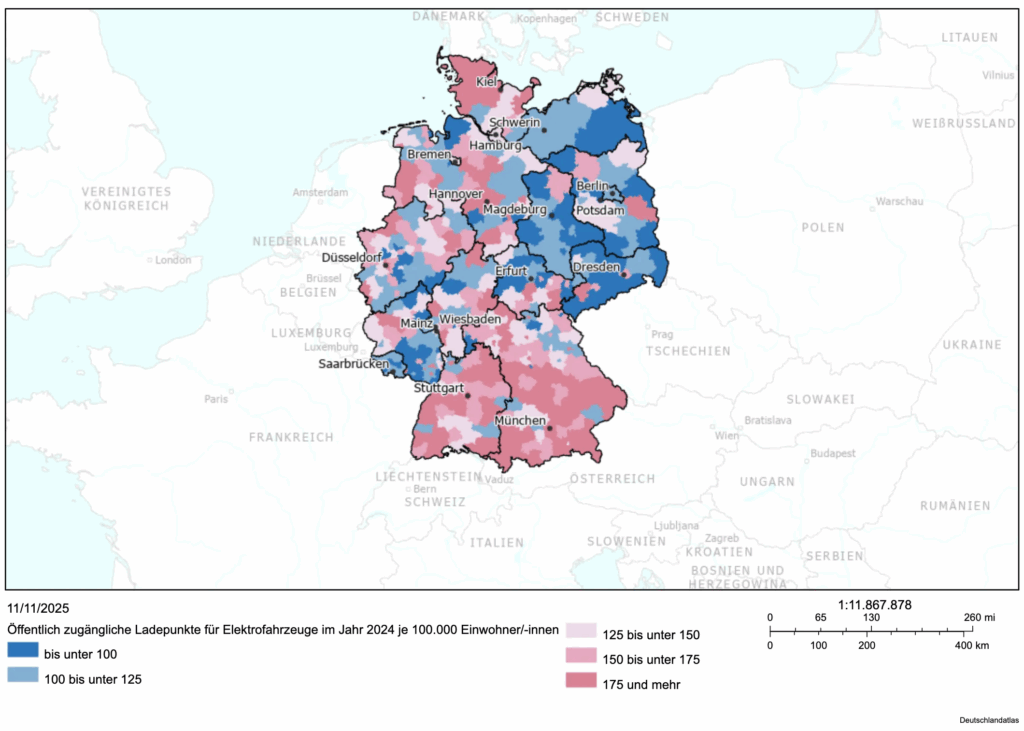
Image 1: Deutschlandatlas [5]
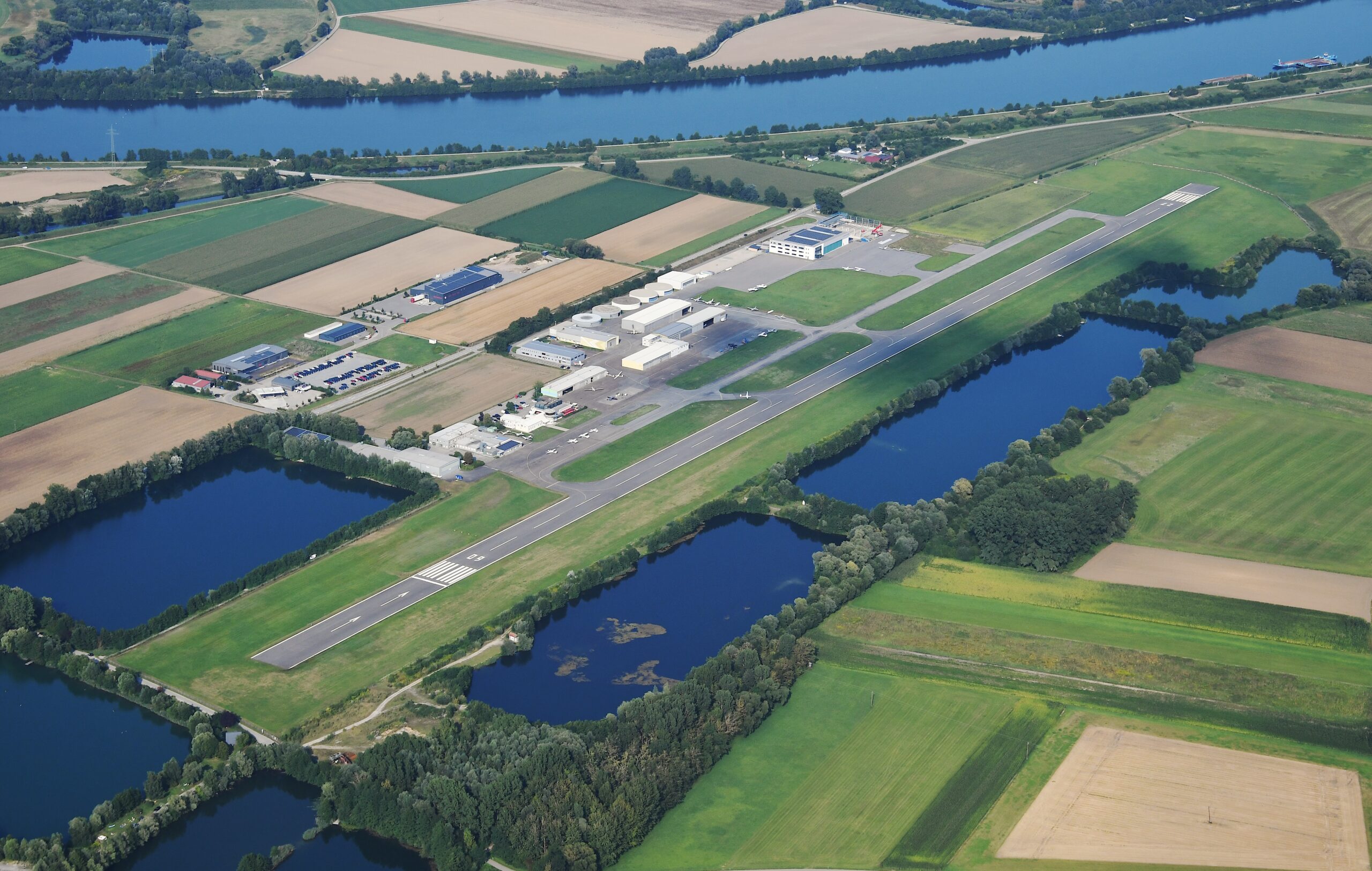
Regional airports illustrate this divide particularly well. Located outside dense urban areas, they are connected to regional distribution grids and operate parking areas that lack high-capacity electrical connections. Expanding charging infrastructure at these sites often requires the installation of new transformer stations or additional grid connections, as demonstrated by recent projects at Paderborn Lippstadt Airport [6]. In contrast, airports such as Erfurt Weimar [7] and Weeze [8] rely mainly on AC chargers with power levels between 11 and 22 kilowatts.
This reflects a clear economic logic: long parking durations favour moderate-power AC charging that can be deployed broadly without the need for costly network reinforcement.
This combination of limited grid capacity and predictable, low-intensity demand positions regional airports as ideal locations for the practical deployment of intelligent, modular charging infrastructure. Their stable traffic flows, extensive parking areas, and long vehicle dwell times create conditions that favour efficient AC-based charging solutions. Such systems can meet passenger and operational needs while integrating smoothly into existing regional grids, supporting the wider electrification of rural mobility without requiring costly network reinforcement.
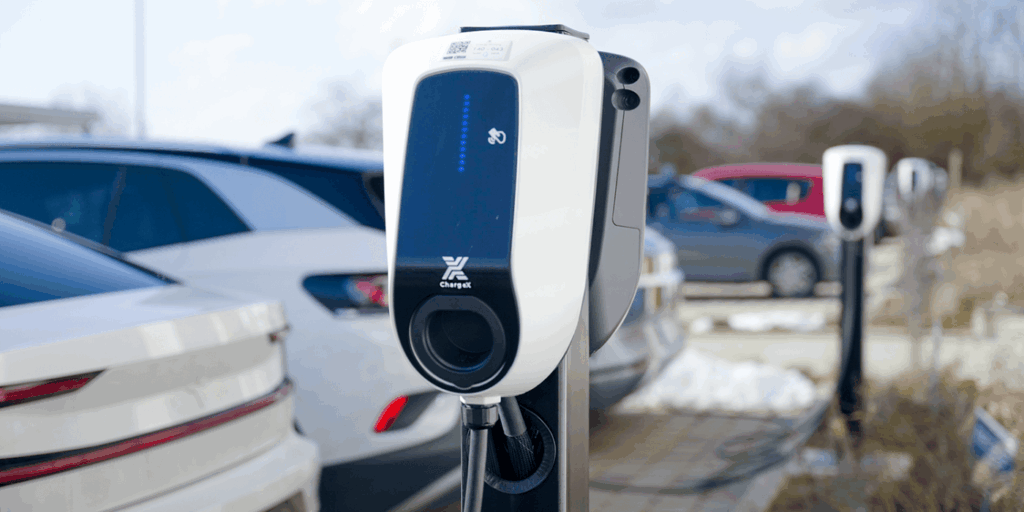
Solving the infrastructure gap at regional airports requires technology that expands charging capacity intelligently within existing grid limits. ChargeX has solved this very problem: Its “Aqueduct” platform enables the modular deployment of AC charging infrastructure and dynamically distributes available power across multiple charging points. The system continuously adapts load profiles based on occupancy, energy availability, and time patterns, ensuring efficient and stable operation even under limited grid capacity.
Benefits for Airport Operators
- Better connectivity for travelers with EVs improves the airport’s competitive edge
- Charging points can be integrated into an existing grid without costly grid upgrades
- The solution can be expanded modularly with additional charging points
- A smart load management ensures efficient energy consumption and distribution
- Integration with solar power and battery storage increases energy independence
- A green and efficient energy concept enhances the airport’s sustainability profile
This configuration is particularly well suited for Park and Fly environments, where vehicles remain parked for extended periods and can be charged gradually without imposing additional stress on the network. By synchronising charging cycles with parking durations and flight schedules, the system guarantees full vehicle readiness while keeping operational and grid-related costs low.
Benefits for Travellers
- Travellers with electric vehicles experience a convenient Park and Fly option
- Travellers may easily set the day of return and desired State of Charge upon return
- Locally generated green solar energy ensures more sustainable travel experience
Together with ALBATROSS’s renewable energy infrastructure, including generation of solar energy through photovoltaic panels and battery energy storage systems, airports can meet a significant portion of their charging demand through locally produced power. Solar energy generated during the day and stored on-site enables efficient overnight and off-peak charging, reducing dependence on external supply and eliminating the need for costly grid expansion. The result is a resilient and economically efficient model for airport electrification that links regional mobility with sustainable, self-sufficient energy production.
ALBATROSS and ChargeX have already launched initial pilot projects at regional airports and plan to scale the solution across the expanding ALBATROSS network, establishing a replicable framework for sustainable mobility infrastructure across Germany.
Sources
[1] Official European market data on alternative-fuel vehicle registrations 2024–2025 –https://alternative-fuels-observatory.ec.europa.eu/general-information/news/germany-bev-market-share-135
[2] Germany: Germany: BEV Registrations Surge by 54% in April 2025 – https://alternative-fuels-observatory.ec.europa.eu/general-information/news/germany-bev-registrations-surge-54-april-2025
[3] Deutschlandatlas : Elektro-Pkw: Zahl der zugelassenen Fahrzeuge steigt –https://www.deutschlandatlas.bund.de/DE/Karten/Wie-wir-uns-bewegen/111-Elektroautos-Pkw-Bestand.html#_iw2nhctzr
[4] Official data from the Federal Network Agency (Bundesnetzagentur) –https://www.bundesnetzagentur.de/DE/Fachthemen/ElektrizitaetundGas/E-Mobilitaet/start.html
[5] Deutschlandatlas : Öffentliche Ladeinfrastruktur für Elektrofahrzeuge –https://www.deutschlandatlas.bund.de/DE/Karten/Wie-wir-uns-bewegen/113-Oeffentl-Ladeinfrastruktur-EAuto.html#_c9cy13npy
[6] Paderborn Lippstadt Airport: Weitere Ladestationen im Aufbau – https://www.airport-pad.com/de/news-media/aktuelles/news-presse/details/news/weitere-ladestationen-im-aufbau/
[7] Erfurt Weimar Airport: Service – Parken – https://www.flughafen-erfurt-weimar.de/service/parken.html
[8] Airport Weeze: Parken – https://airport-weeze.com/parken/
[9] Website ChargeX – https://www.chargex.de