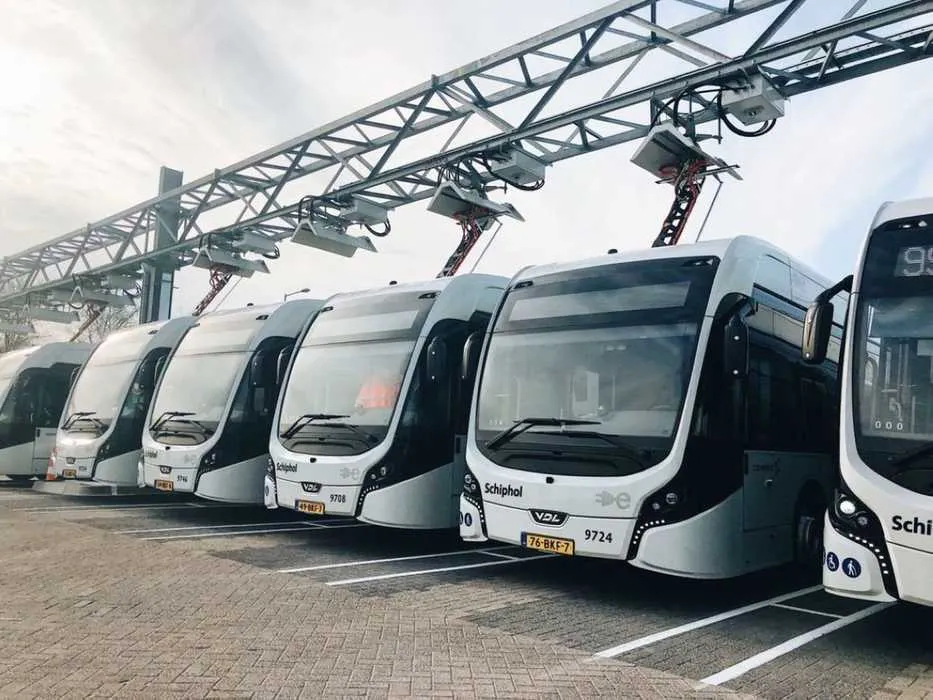
The electrification of public transit is no longer a future vision—it is proven reality. In Dortmund, 30 electric buses operated by DSW21 cover over 300 kilometers daily in regular scheduled service. At Stuttgart Airport, electrifying the bus fleet reduced ground transportation CO₂ emissions by 86 percent over a decade [13]. At Schiphol Airport, Connexxion has operated Europe’s largest electric bus fleet since 2018, with over 100 vehicles in public transit service [12].
Favorable Total Cost of Ownership
The purchase price of a 12-meter electric bus, ranging from €473,000 to €600,000, is significantly higher than a comparable diesel bus at approximately €220,000. However, when examining the total cost of ownership over the service life, a different picture emerges: Data from 30 Polish cities shows that an electric bus with depot charging reaches lifecycle costs of €2.55 million over 14 years, while a diesel bus amounts to €2.92 million. The cost structures differ fundamentally: For electric buses, approximately 49% of TCO is attributable to acquisition and only 16.5% to electricity, whereas for diesel buses, fuel costs represent the largest share at around 53%, with acquisition accounting for only about 26% [1].
The lower operating and energy costs of electric buses compensate for the higher initial investment over the service life.
Environmental Benefits for Health Resorts
The transition is particularly relevant for certified health resorts and spa towns, as electric buses produce no local tailpipe emissions, thereby protecting the air quality that is central to these destinations’ value proposition.
Sustainability as a Competitive Factor in Tourism
The combination of sustainable travel and emission-free local mobility becomes a competitive advantage in tourism marketing. Guests experience sustainable mobility firsthand: from the train station or airport to their accommodation, from their accommodation to attractions. Especially during seasonal traffic peaks (summer, holiday periods), public transit demand is high and visibility correspondingly significant.
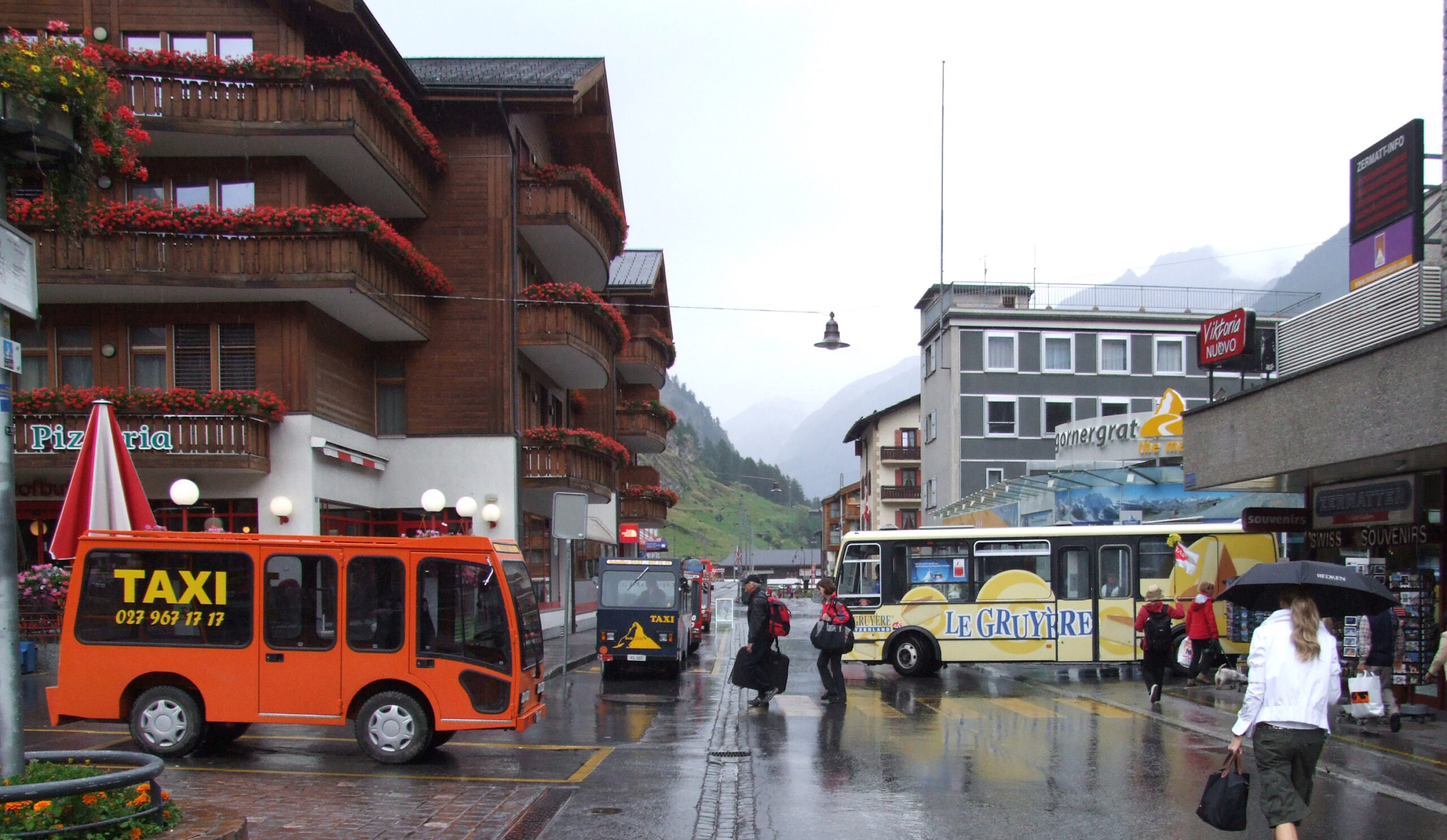
The most famous example is Zermatt in Switzerland. The resort at the foot of the Matterhorn has been closed to private motor vehicles since 1931—residents have confirmed this status in three referendums. Visitors arriving by car park in Täsch, five kilometers away, and continue by train. Within the village, only electric vehicles are permitted: electric buses, electric taxis, and delivery vehicles for hotels and shops, all limited to 20 km/h. Car-free status has become as central to the brand as the Matterhorn itself: fresh air and tranquility as part of the vacation experience [2].
Airports as Strategic Infrastructure Partners
The electrification of public transit often fails not due to lack of will, but due to infrastructure constraints: Where does the electricity come from? Where is there sufficient space to charge the buses? Who coordinates the grid expansion? Regional airports can play a key role here.
Airports have considerable land reserves. On the landside, parking areas and peripheral zones offer space for PV carports, battery storage, and bus depots. On the airside, open areas and rooftops are available for solar installations. Munich Airport demonstrates how this works: On parking structures P43 and P44, 7,216 PV modules with a capacity of three megawatts generate solar power—enough for approximately 1,000 three-person households. This electricity directly feeds Bavaria’s largest EV charging park with 275 charging points [3]. In parallel, the airport has deployed 37 electric buses for apron operations, with the goal of achieving climate neutrality by 2035 [4].
The Schiphol example goes even further. Amsterdam Airport financed and built the charging infrastructure for 100 electric buses that have been operating in public transit around the airport since 2018. The facility with 13 MW charging capacity was the world’s largest fast-charging depot at the time of commissioning [5]. Bus services run 24/7 on six routes—Schiphol made zero-emission buses a requirement for awarding the transit contract. The goal: climate neutrality by 2040 [6].
Geographic location adds another advantage. Regional airports are typically located 10 to 30 kilometers outside city centers, in the transition zone between urban and regional areas. This makes them natural hubs for public transit. Bus connections for employees and passengers usually already exist. Infrastructure for electric buses integrates into existing traffic flows.
Airports are also, by definition, multimodal hubs: aircraft, buses, trains, and taxis converge here. For energy infrastructure, this represents a decisive advantage: multiple user groups can share the same facilities. Public transit buses, apron buses, and cargo vehicles charge at the same infrastructure. This bundling increases utilization and improves economic viability—an argument that counts with investors and energy providers.
Implementation Challenges
Infrastructure and Grid Capacity
Charging electric buses typically requires 50 to 150 kW per vehicle. For a fleet of 30 buses, this quickly adds up to several megawatts of connection capacity. In most cases, this necessitates upgrading the grid connection.
The German Energy Agency documents the reality: logistics companies report that two to three years can pass from initial planning to commissioning a charging point—in some cases up to ten years. Companies report waiting times of up to one year for initial responses from grid operators and up to 2.5 years for the actual grid connections. Compounding the problem: grid operators frequently provide no binding commitments on when required connections will be available—this makes investments riskier and leads to long lead times [7].
Contract Durations and Investment Risk
Public transit contracts have regulatory limits on their duration. Under EU Regulation 1370/2007, contract terms are generally limited to ten years for bus services and 15 years for rail services [8]. Charging infrastructure, however, has a technical lifespan of fifteen years or more; transformer stations and grid connections last several decades.
The result is a classic investment dilemma: Who finances infrastructure whose economic use beyond the contract term is uncertain? A transit operator with a current contract running until 2035 understandably hesitates to invest in infrastructure that will only be fully amortized by 2040—since winning the follow-up contract is uncertain.
Schiphol demonstrates how this problem can be solved: The airport financed and built the charging infrastructure on airport grounds itself [6]. Schiphol assumed the infrastructure investment, while transit operator Connexxion is responsible for the buses and operations. The concession runs from December 2017 to December 2027 [5], but the charging infrastructure remains at the airport and can be used by a successor operator in case of a change. The Amsterdam Transport Authority and Schiphol decided that zero-emission buses would be a criterion for the tender [6]. The airport was able to make zero-emission buses a tender requirement because it had already provided the infrastructure.
This model decouples infrastructure investment from shorter transit contract cycles—and makes projects financeable that would otherwise fail due to investment risk.
Financing and Power Purchase Agreements
Bank financing for PV systems and battery storage requires adequate power purchase agreements (PPAs). Most PPA contracts have a relatively long duration of 10 to 15 years. Especially for new-build PPAs, providers need long contract terms to obtain financing for their projects at all [9]. The commitment to long-term offtake over often 10 to 20 years provides the necessary creditworthiness for investments [10].
Transit operators with their shorter service contracts often cannot provide this security. A transit company whose current contract expires in eight years is not an ideal PPA partner for a fifteen-year power offtake agreement.
The alternative—full feed-in of generated power to the public grid—often fails due to the same grid bottlenecks that delay the connection of charging infrastructure.
Anyone who has to wait two years for a PV system grid connection and then has no guaranteed offtake will hardly make the investment.
Airport Master Planning and Land Use Strategies
Airports must balance competing uses: hangar development, parking, bus depots, PV systems—all require space. The National Charging Infrastructure Control Center identifies the problem: Space is a scarce resource on operational sites and logistics depots [11].
Without long-term planning, suboptimal decisions threaten to block future expansions. A PV carport optimally positioned today may prevent construction of a maintenance hangar tomorrow. A bus depot designed for 20 electric buses cannot easily be expanded to 50 buses if the adjacent area has been developed for other purposes in the meantime.
The problem is exacerbated by the dynamics of technological development: Those planning today must also reserve space for technologies that will only be market-ready in five or ten years—from hydrogen refueling stations to charging infrastructure for electric regional aircraft.
The ALBATROSS Approach: Airports as Energy, Mobility, and Logistics Hubs
The challenges of public transit electrification are real, but solvable. What is missing is not the technology, but a partner who manages the complexity and puts all the pieces together.
Holistic Approach Instead of Isolated Solutions
A PV carport alone does not solve the problem. Neither does a battery storage system alone. Only the integration of PV, storage, charging infrastructure, grid connection, and user coordination creates a functioning airport energy hub.
ALBATROSS pursues a strategic, long-term planning horizon spanning several decades. This is crucial: Grid connections have lead times of several years; PV and storage investments amortize over ten to fifteen years; transit contracts run eight to ten years; and the development of electric regional aircraft extends over the next decade. A partner who plans across all these time horizons creates investment security for all stakeholders.
Concrete Benefits for Airports
The airport becomes an energy service provider, generating revenue from infrastructure provision and electricity sales. With existing charging infrastructure, it can define zero-emission buses as a requirement in transit tenders—as Schiphol has demonstrated. The infrastructure built today for buses forms the foundation for electrifying apron operations and, in the future, electric regional aviation. On-site generation and storage reduce dependence on external energy suppliers and protect against price volatility.
About ALBATROSS
ALBATROSS develops, finances, and operates integrated infrastructure for energy, mobility, and logistics in partnership with regional airports. By combining renewable energy solutions, electrification strategies, and logistics innovation, ALBATROSS enables airports to remain vital economic drivers while preparing for the future of sustainable aviation. With offices in Hamburg and Munich, ALBATROSS is rapidly expanding its partner network across Germany and Europe.
For media inquiries or interview requests, please contact:
Marius Wedemeyer
Email: mw@albatross-holding.com
Phone: +49 (0) 172 3071039
Website: www.albatross-holding.com
Sources:
[1] Ghotge, R.; van Rooij, D.; van Breukelen, S.: Total Cost of Ownership of Electric Buses in Europe. World Electric Vehicle Journal 2025, 16(8), 464. https://doi.org/10.3390/wevj16080464
[2] Zermatt Tourismus: Zermatt ist autofrei. https://www.zermatt.ch/nachhaltigkeit/Elektros-Autofrei-Anreise/Zermatt-ist-autofrei
[3] Flughafen München GmbH: Flughafen München eröffnet Bayerns größten Ladepark für E-Autos. Pressemitteilung, September 2025. https://www.munich-airport.de/presse-flughafen-muenchen-eroeffnet-bayerns-groessten-ladepark-fuer…-35255398
[4] Flughafen München GmbH: Flughafen München weiht neues eBusdepot ein. Pressemitteilung, August 2025. https://www.munich-airport.de/presse-flughafen-muenchen-weiht-neues-ebusdepot-ein-34688344
[5] Europe’s largest electric bus fleet operates around Schiphol. https://aviationbenefits.org/newswire/2018/03/europes-largest-electric-bus-fleet-operates-at-and-around-schiphol/
[6] Schiphol Group: Big electric bus fleet. https://www.schiphol.nl/en/sustainability/to-and-from-the-airport/biggest-electric-bus-fleet/
[7] Deutsche Energie-Agentur (dena): Dossier Ausbau der Ladeinfrastruktur für E-Lkw – Herausforderungen und Lösungsansätze. 2025. https://www.dena.de/fileadmin/dena/Publikationen/PDFs/2025/Dossier_Ausbau_der_Ladeinfrastruktur_fuer_E-Lkw_BF.pdf
[8] Verordnung (EG) Nr. 1370/2007 des Europäischen Parlaments und des Rates vom 23. Oktober 2007 über öffentliche Personenverkehrsdienste auf Schiene und Straße, Art. 4 Abs. 3. https://eur-lex.europa.eu/legal-content/DE/ALL/?uri=celex:32007R1370
[9] EHA Energie-Handels-Gesellschaft: Power Purchase Agreement: Grünstrom langfristig sichern. 2024. https://www.eha.net/blog/details/power-purchase-agreement.html
[10] WWF Deutschland: PPA: Beschaffung über direkte langfristige Lieferverträge. 2025. https://www.wwf.de/themen-projekte/klimaschutz/oekostrom-next-generation/beschaffungsleitfaden/direktbeschaffung-durch-ppa
[11] Nationale Leitstelle Ladeinfrastruktur: Ladeinfrastruktur für Nutzfahrzeuge, Task-Force Depotladen. https://nationale-leitstelle.de/nutzfahrzeuge/
[13] Elektromobilität am Flughafen Stuttgart – https://www.stuttgart-airport.com/de/unternehmen/nachhaltigkeit/strzero/elektromobilitaet
[14] Elektrotaxi und Elektrobus als ÖPNV in Zermatt – https://de.wikipedia.org/wiki/Datei:Elektrotaxis_und_Elektrobus_in_Zermatt.jpg